
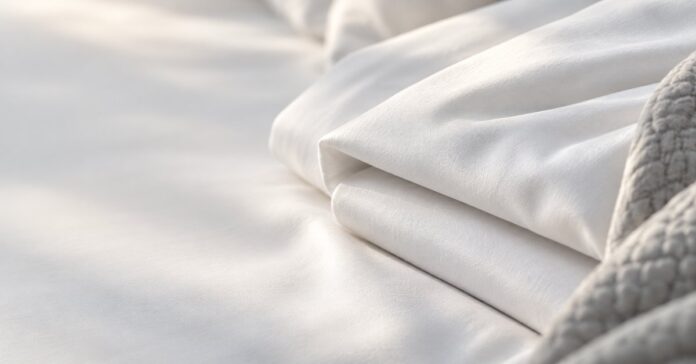
Shopping for bedsheets, you’ll see numbers everywhere: 400 thread count, 1000 thread count, 60s yarn. Bigger sounds better, but the number on the packet doesn’t always tell you how a sheet will feel. Here’s what yarn count and thread count actually mean, why we rate our bedsheets by yarn count, and what to look for in sheets for Singapore’s warm, humid nights.

The quick answer
- Yarn count tells you how fine each thread is. The higher the number, the thinner and finer the yarn, and the softer and smoother the fabric.
- Thread count tells you how many threads are woven into one square inch of fabric. It says nothing about how fine those threads are.
- A sheet woven from fine yarn feels softer and breathes better than one with a big thread count made from thick, twisted yarns.
What is yarn count?
Yarn count measures the fineness of a single yarn. In cotton, it’s written with an “s”, like 40s or 60s. The higher the number, the more thread can be spun from the same weight of cotton, which means each strand is thinner.
| Yarn count | How it feels | Typical use |
|---|---|---|
| 20s–30s | Thicker, sturdier, a little coarse | Budget sheets, heavier fabrics |
| 40s | Soft, everyday comfort | Most standard bedsheets |
| 60s and above | Finer, smoother, drapes better, feels cooler | Premium bedsheets |
Our Nuloft bedsheet sets are woven from fine 60s yarn, finer than the yarn used in most everyday sheets.
What is thread count?
Thread count is the number of threads, lengthwise and widthwise, in one square inch of fabric. A sheet with 200 lengthwise and 200 widthwise threads has a thread count of 400.
A higher thread count can mean a denser, smoother fabric, but only up to a point. The number can be pushed up by twisting several thin strands together into one thicker “multi-ply” yarn and counting each strand separately. That gives an impressive number on the packaging, but the result is a heavier sheet that traps more heat.
Why we rate our bedsheets by yarn count
Thread count only tells you how tightly a fabric is packed. Yarn count tells you how fine the yarn is, and that’s what you actually feel against your skin. It’s also a number that can’t be inflated by twisting yarns together.
That matters even more in Singapore. A sheet made from fine yarn is lighter and lets air through, so it feels cooler on humid nights. A heavy, high-thread-count sheet can feel stuffy, however soft it looks in the shop.

Fabric and weave matter too
Yarn count isn’t the whole story. Two more things decide how a sheet feels:
- Fibre. Combed cotton has the short, rough fibres brushed out, so only the long, smooth ones are woven. TENCEL™ lyocell, made from wood pulp, feels silkier than cotton and is good at drawing moisture away from your skin.
- Weave. Sateen weaves float more yarn on the surface, giving a smooth, soft sheen. Percale is crisper and more matte.
Our bedsheet sets
| Set | Fabric | Yarn | Feel |
|---|---|---|---|
| Nuloft Dreamer | 100% combed cotton sateen | 60s | Soft and smooth with a gentle sheen; our bestselling set |
| Nuloft Radiant | 100% combed cotton sateen | 60s | Same soft sateen in two-tone colourways |
| Nuloft Natural Tencel | 100% TENCEL™ lyocell | 60s | Silky, cool and breathable for hot sleepers |
Each set comes with a deep fitted sheet that fits mattresses up to 40cm thick, a quilt cover and matching pillowcases, in Singapore and Japan sizes. Not sure which size you need? See our mattress size guide.

How to choose bedsheets for Singapore’s weather
- Look for fine yarn. 60s yarn or finer feels softer and lighter.
- Choose breathable fibres. Combed cotton and TENCEL™ breathe better than polyester.
- Check the fitted sheet depth. Thick mattresses need a deep pocket. Ours fit up to 40cm.
- Don’t chase thread count. A very high number often means heavier, multi-ply yarn, not a better sheet.
- Pair it with a cool mattress. Sheets are one half of a cool bed. Our cooling mattress guide covers the other half.
Buying a mattress too? Bedding accessories get an extra 20% off with code PWB20 when you buy any mattress. See Bundle & Save. Shop all bedsheet sets.
FAQ
What does 60s yarn count mean?
It tells you how fine each thread is. The higher the number, the thinner and finer the yarn. 60s yarn is finer than the yarn used in most everyday sheets, so the fabric feels softer and smoother and drapes better.
Is yarn count or thread count more important?
Yarn count tells you more about how a sheet will feel, because it measures how fine the yarn is. Thread count only measures how many threads are packed into a square inch, and it can be inflated by twisting yarns together.
Is a higher thread count always better?
No. Above a certain point, a higher thread count usually comes from thick, multi-ply yarns, which make sheets heavier and less breathable.
What bedsheets are best for hot weather?
Light, breathable sheets in fine yarn, such as 60s combed cotton or TENCEL™ lyocell. They let air through and feel cooler than heavy or synthetic fabrics.
What is the difference between cotton sateen and TENCEL™?
Cotton sateen is soft and smooth with a gentle sheen. TENCEL™ lyocell feels silkier, breathes better and is good at drawing moisture away from your skin, so it feels cooler on humid nights.
